
 Cait Charles
Table of Contents
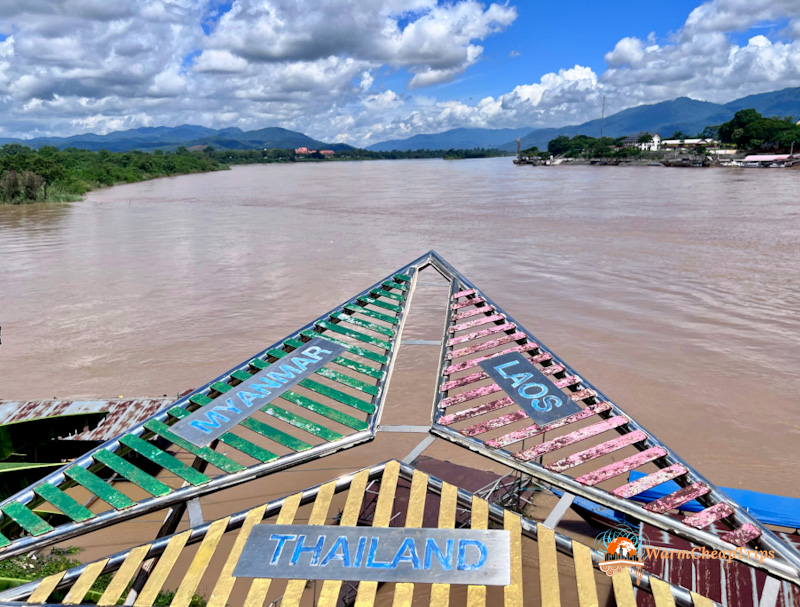
The Golden Triangle. Sounds picturesque, right? And it is – it’s right at the junction where Thailand, Myanmar, and Laos all meet in a majestic blend of river and mountains, and there are indeed plenty of gorgeous viewpoints galore. But unbeknownst to me (before), the area is famous for something much darker.
In late 2024, it was my time to undergo every digital nomad’s least-anticipated ritual: the dreaded visa run (also known as a border bounce). I didn’t mean to, but I ended up doing a visa run at Thailand’s golden triangle border checkpoint. I’d done dozens of visa runs over the years, but boy oh boy was I unaware of what I was in for with the golden triangle visa run.
Thailand is always changing the visa run/border bounce rules–and the latest update, as of November 2025, is sending shockwaves through the traveler and digital nomad communities as we speak. At the end of this article, I’ll fill you in on the recent changes and the ins and outs of Thai visas, especially for digital nomads–but first, I’ll share a visa run story like no other.
Since I was in Chiang Mai, I decided to do the visa run at the Chiang Saen border in northern Thailand’s Chiang Rai province. Like the cheapskate I am, I also decided to take the local Greenbus from Chiang Mai to nearby the border instead of paying for a visa run service.
As it turned out, the greenbus’ arrival near the border at dusk and the closing time of the immigration checkpoint are prettttty close together. So after walking the last leg of the journey as fast as I could, I arrived at a closed border checkpoint and had to haphazardly make my way to another one nearby that wasn’t quite closed yet.
I stamped out of Thailand easily and boarded a motorboat across the Mekhong River at sunset. Is there anything more picturesque?
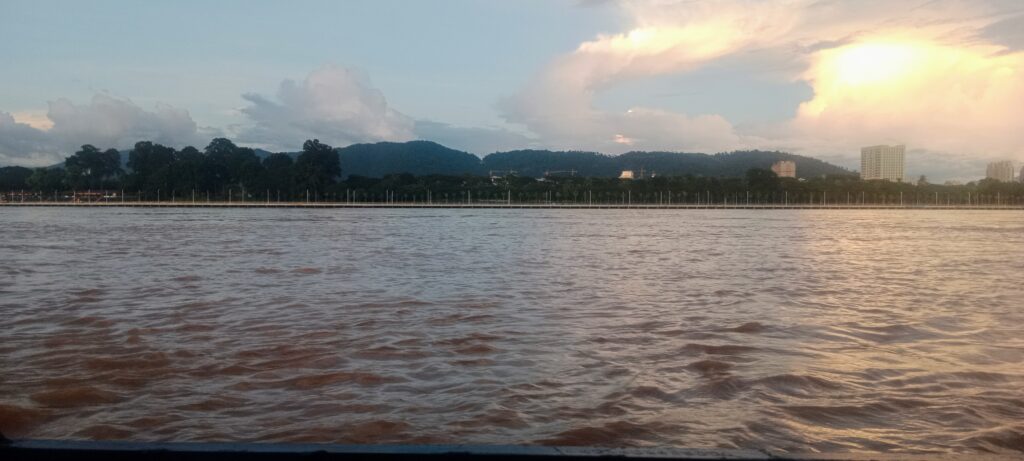
As the boat flowed down the river, I began to notice strange, futuristic-looking buildings on the other side. I’d been to Laos before, but hadn’t ever seen anything quite like those buildings. Laos is a country that struggles a lot, and it’s not usually so…developed. Or fancy. Or…weird.
Where I was going, though, wasn’t exactly Laos even though it was technically within Laos borders. I didn’t know that yet, but I was about to find out.
Arriving in the Golden Triangle Special Economic Zone for my Border Bounce
When the boat docked, I went through the checkpoint, exited on the other side, and pulled out my phone in order to get directions to the hotel I’d pre-booked, in Huay Xai. That’s when I discovered that I’d gotten my border towns mixed up. My hotel was an hour and a half away from where I’d popped out.
But, transportation in Laos is pretty cheap, so I was hopeful I could find a bus. I went to speak with some immigration or tourism agents who were set up at a table outside the checkpoint. Of course, I knew that we’d have to use Google translate, but…they didn’t seem to be able to read Laotian.
After listening to them speak, I realized that they were actually speaking Chinese, not Thai or Laotian. With this new piece of information, we began corresponding effectively, and more information soon came to light: This area was not exactly Laos.
This was the Golden Triangle Special Economic Zone. I’d never heard of it, but here I was. Apparently, the area was built and controlled by China. And, also apparently, there was no public transportation at all. There were just some drivers who could take me to a hotel in a town nearby.
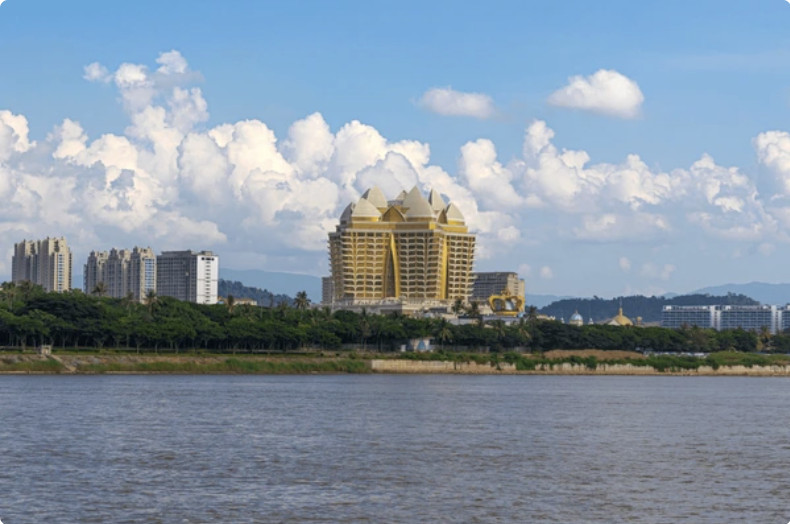
My Accommodation in the Golden Triangle Special Economic Zone
I started asking the border people about hotel prices and soon found out that this area only uses Chinese Yuan (which was graciously on offer for an absolutely criminally-high exchange rate), and the absolute cheapest possible room that we might find, or might not, would be the equivalent of about $60 USD.
Given that I only planned to sleep for about 6 hours by waking right back up to cross back into Thailand again, and given the aforementioned cheapskate behavior, this did not seem like a compelling option.
However, I I’d packed my sleeping mat and neck pillow due to fears about the mattress and pillow in the cheap place I’d booked. Finding myself actually quite well-equipped to camp, I decided to explore the area and see whether there might be a cute, secluded park or something.
Walking down the street, it struck me how perfectly-manicured everything was. The grass was cut all to the same length. The hedges were shaped into elaborate forms. The streets were paved with perfect uniformity, not a pothole in sight. But oddly, there were very few people around anywhere. The place had an eerie feeling to it.
Eventually, I did find a large public park, and it was quite nearby the immigration checkpoint. I ventured to the back of the park, away from the road, where no one would be able to glimpse the foreign-looking girl sleeping there alone.
The back of the park was…sketchy, overgrown, and full of prickly plants. But, I began to set up camp on a sort of wooden board that perhaps some other vagabond had slept on before.
Before long, ants discovered my board, and they seemed to want to share. Also, I was scared. I didn’t want to be scared, I wanted to be a badass digital hobo adventurer who’s as happy in a sketchy park as she is in a comfy apartment.
So, dejectedly and with my tail between my legs, I returned to the border checkpoint to tell the people there that I would concede and accept their offer to be driven, for an exorbitant price, to the fancy hotel with the fancy Chinese yuan and sleep for a not-so-fancy 5 hours at this point before paying more fancy money to come right back to the border checkpoint.
Upon arriving back, a woman explained to me that the drivers had all gone home. Hope rose in my chest. Maybe I could just sleep at the border checkpoint! This was literally the best possible option – easy, cheap, and more time for sleep. The border guards working there agreed, and told me that they would watch over me. I found that sentiment sort of cute and a little bit annoying. I didn’t need them to watch over me, but it was endearing that they wanted to busy themselves by doing so–or so I thought at the time.
One of the border guards went away and returned with a big, fluffy blanket for me to use. Another opened a cabinet and produced a bicycle pump, which he used to pump up my mat for me. Yet another brought me a bag of takeaway food–an extra portion that no one had opened yet. This was Laotian (or Chinese?) hospitality at its best!
Golden Triangle provided Food at the Border Checkpoint: Rare Wildlife?!
With a mixture of trepidation and curiosity, I started sorting through the contents of my dinner.
Aside from some rice, there wasn’t anything I recognized. One item consisted of these sort of cube-shaped bones with what looked like mushrooms growing out of and around them–but was definitely a part of an animal. I didn’t like it very much, but I was hungry and polite, so away I munched.
The next dish was something that I can only describe as a cartoon character. The rough shape of it was almost like an octopus. But nothing else other than the shape was octopus-like.
The material was soft, light, and almost spongy, with a pinkish-orange hue.On the inside were these tiny little sort of pustules..
This one was tastier than the other, especially with rice–but with each bite I grew more apprehensive. I just had no clue what I was eating, and while there was a bit of familiar saltiness, nothing else about the flavor was remotely recognizable.
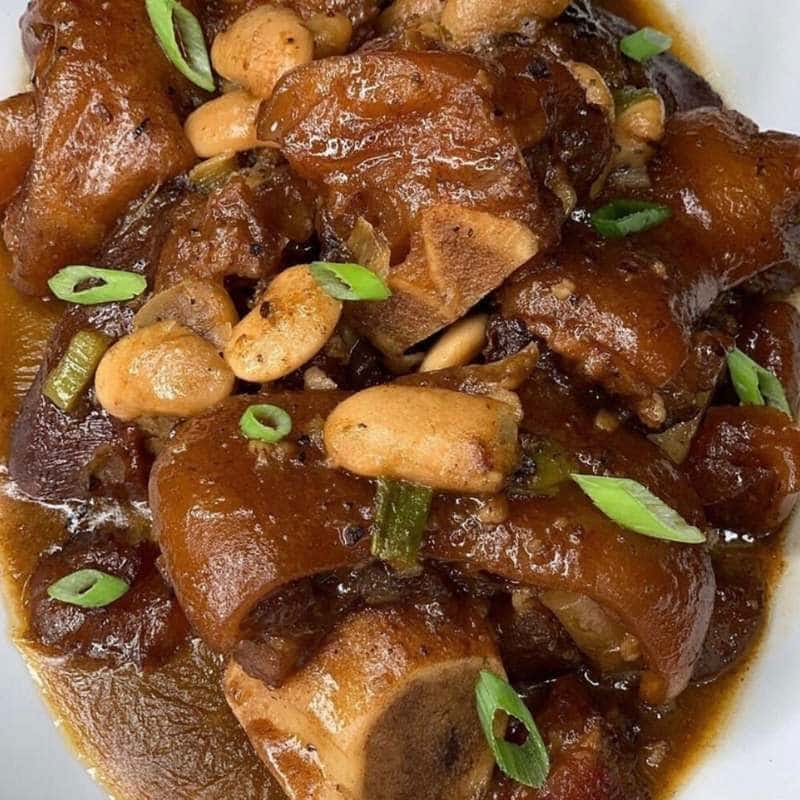
After my meal, I went to bed under the watchful (and a bit too friendly) gaze of one of the border guards.
After about 5 hours, one of the guards woke me up and told me it was time to go. Sleepily, I crammed the mat back into its bag and set off back through the checkpoint and across the river. Luckily, the excitement of the trip had reached its peak the previous night, and there were no more surprises during the journey.
The Truth About the Golden Triangle
There was a surprise when I arrived back in Chiang Mai, however. I related the story of my crazy visa run to a friend. Wide-eyed and mouth agape, he sputtered “wait–you actually went to the Golden Triangle Special Economic Zone?!”
“Yes…” I answered, confused. That’s when he explained to me that this area is world-famous, but not in a good way. Nope. This exact place is known for trafficking of humans, drugs, and rare wildlife.
It’s the sort of place where there are huge office buildings full of people who have been kidnapped and enslaved in online scam endeavors. Those guys who convince middle-aged white women to fall in love with them over the internet, then to invest in fabricated investment schemes that end up stealing people’s life savings? Yep, those dudes might just be sitting in an office building in the golden triangle special economic zone – and half of them aren’t even dudes.
The place is run by a Chinese mafia boss who facilitates the flow of all manner of illegal goods. And when I learned that rare wildlife is trafficked through there, I started to really wonder what I’d eaten.
My takeaway? Don’t assume everywhere is safe, even if–especially if–you’ve grown accustomed to inhabiting places where you can leave your new Macbook on the table at a cafe while you go to the bathroom. And, plan carefully enough to know what time the border checkpoint closes, and how exactly you’ll get to your hotel.
The Thai Visa Lowdown for Tourists and Digital Nomads
- Most nationalities are eligible for 60 days visa-free entry in Thailand, which can be extended by another 30 days at your local immigration office.
- Thai embassies and consulates worldwide also offer tourist visas with the same time restrictions described above.
- There’s also the multiple-entry tourist visa (METV) that allows multiple stays up to 60 days each throughout a period of 6 months, with one 30-day extension of stay possible during that time
- There’s now a Destination Thailand Visa (DTV) available for digital nomads and those who do long-term soft power activities such as Thai cooking classes, Muay Thai, or medical tourism. It’s valid for 5 years and allows stays of up to 180 days at a time. After 180 days, one can either extend for another 180 days at an immigration office (lots of paperwork, not recommended) or simply leave for a few days and come back.
New Visa Restrictions in Thailand as of November 2025
Things have gotten stricter – here are the latest updates as of 18 November, 2025, but keep in mind tht the situation is still evolving.
- If you try to enter visa-exempt more than two times per year, you may be denied because the immigration officer may think you are not a genuine tourist. You need a good reason to do this.
- You’ll be especially heavily-scrutinized if you haven’t returned to your country of residence between visits to Thailand.
- Your first visa-exempt 60-day entry can still be extended by 30 days, but if you try to do the same thing on your second visa-exempt entry, you might only get 7 days – and extensions in general will be more carefully scrutinized and more frequently denied in the cases of repeat visitors.
- If you enter Thailand by land, you may not be allowed to extend your visa.
- Same-day border bounces may or may not be allowed; the information has been changing daily and has yet to settle into a new rhythm.
Whether you’re coming to Thailand as a tourist, digital nomad, student, or retiree, it’s important to understand the constantly-evolving visa landscape in order to guarantee that your entry and/or extension goes as smoothly as possible.
As for the Golden Triangle, it may look like an idyllic swirl of rivers and borders, but my accidental detour into its Special Economic Zone was a stark reminder of the importance of knowing a thing or two about where you’re going and what to watch out for.
So, stay alert, plan ahead, and understand that even “easy” Southeast Asia isn’t always predictable…but it is an adventure!
If you enjoyed reading this article, check out some of my other posts on Lost & Lore!
Is the Golden Triangle visa run safe?
The Golden Triangle border crossing itself is generally safe, but parts of the surrounding area, especially the Golden Triangle Special Economic Zone, are controversial and widely associated with organized crime, trafficking, and scam operations. Travelers should avoid wandering, stay near official checkpoints, and have transportation and accommodation planned in advance.
What is the Golden Triangle Special Economic Zone?
The Golden Triangle Special Economic Zone is a Chinese-controlled enclave inside Laos near the Thailand–Laos border. While technically in Laos, it operates under different rules, uses Chinese yuan, and caters heavily to Chinese tourism and business interests. The area has gained international notoriety for alleged involvement in scams, gambling, and trafficking.
Can you accidentally end up in the Golden Triangle Special Economic Zone?
Yes. If you do a visa run via Chiang Saen or nearby northern border crossings, it is surprisingly easy to cross into the Golden Triangle Special Economic Zone without realizing it, especially if you are unfamiliar with the area or traveling independently instead of with a visa run company.
Is the Golden Triangle a common place to do a Thailand visa run?
No. Most travelers use Laos crossings near Nong Khai or Mukdahan, or fly to nearby countries. The Golden Triangle is less common, more confusing, and not recommended for first-time visa runs.
Can you do a same-day border bounce at the Golden Triangle?
As of late 2025, same-day border bounces are inconsistent and may be refused at the discretion of immigration officers. Travelers attempting repeat visa-exempt entries are more likely to be questioned or denied.
How many times can you enter Thailand visa-free in 2025?
As of November 2025, travelers may be allowed up to two visa-exempt entries per year. Additional entries may be denied if immigration officers believe the traveler is not a genuine tourist, especially if they have not returned to their home country between visits.
Can you extend a 60-day visa-free stay in Thailand?
Yes. A 60-day visa-free stay can usually be extended once for 30 days at a Thai immigration office. However, repeat extensions are being more closely scrutinized, and second extensions may be shortened or denied.
Are land border entries treated differently than airport entries?
Yes. Land border entries are more heavily scrutinized than airport arrivals. In some cases, travelers entering Thailand by land may not be allowed to extend their stay at all.
Should digital nomads still rely on visa runs in Thailand?
Visa runs are becoming increasingly risky. With stricter enforcement and unclear policies, travelers who plan to stay long term in Thailand are strongly encouraged to pursue a proper visa rather than relying on repeated border bounces.

 Kayla Cosmos
 Trevor Carlson

 Cait Charles

 Prapti Shahkumar