
 Prapti Shahkumar
Table of Contents
A Small Act of Kindness on the Camino Finisterre
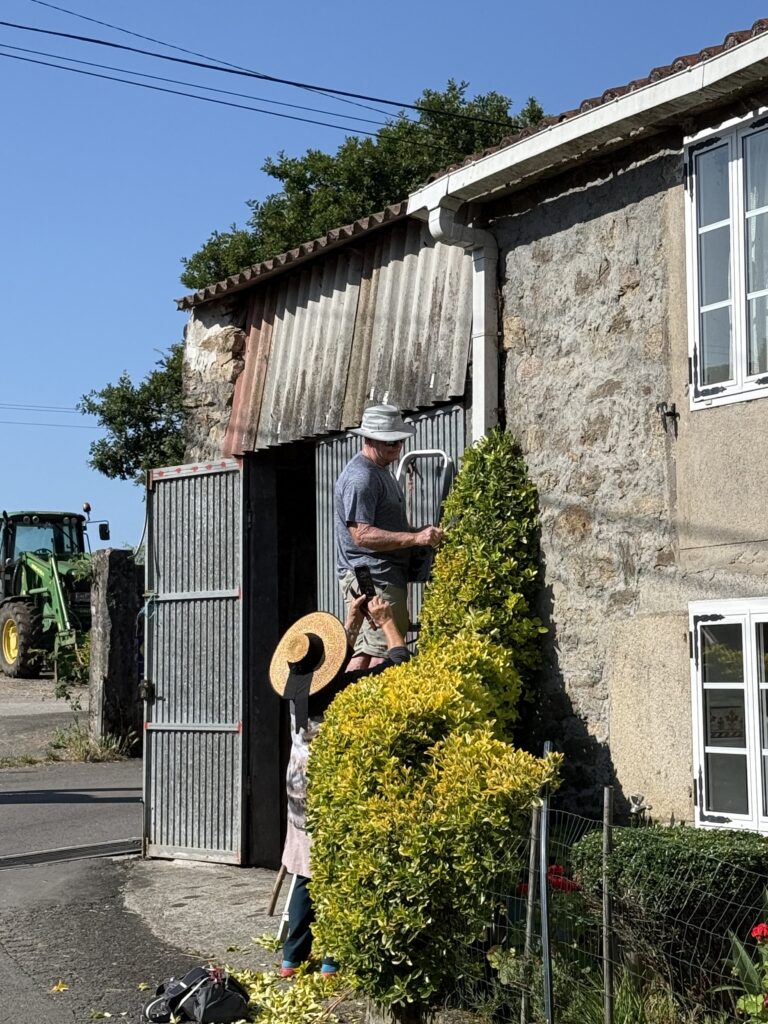
As often happens on a long walk, we had drifted into our own rhythms, lost in our own thoughts. I had stopped to snap a photo of a weathered hórreo – those stilted stone granaries that dot the Galician countryside – and had fallen behind longtime friend Pat. The narrow lane wound into a small village, and I was surprised to round a corner and find Pat up a ladder with a set of hedge trimmers in his hand. An aged local woman was pointing out sections that he hadn’t yet trimmed to her exacting specifications.
Pat explained that the woman had flagged him down as he trekked past. His Spanish didn’t help him understand her Galician, it being more closely related to Portuguese, but she was able to make her needs known through expressive gestures. Since he was taller and at least a generation younger than her, she was sure that God had sent him to trim the upper part of her climbing vine.
My wife Francie and Pat’s wife Diane caught up to us as Pat finished his yard work, and after hugs from the old woman, we continued on our Camino Finisterre adventure. We had opted for a guided trip through Spanish Steps, which provides a couple of guides who give daily briefings and any necessary support, a van, and nightly stays in hotels or local bed and breakfasts. Diane and I, as avid backpackers, are used to stuffing a few essentials into a pack and heading into the wilderness. This was a different type of adventure, but it meant we got to share it with our respective spouses, who prefer nightly showers and soft beds.
The Camino de Santiago, often simply referred to as “the Camino”, is a network of ancient pilgrimage routes all converging at the cathedral in Santiago de Compostela, believed to hold the remains of Saint James. Its origins date back to the 9th century, and it quickly became one of the most important Christian pilgrimages in medieval Europe, rivaling those to Jerusalem and Rome. Before starting our trek, we spent a morning at the Pilgrimage Museum, captivated by maps showing all the different routes ending in Santiago, and by the artifacts and stories tracing the roots of pilgrimage itself.
Walking Beyond Santiago: Choosing the Camino Finsterre Route
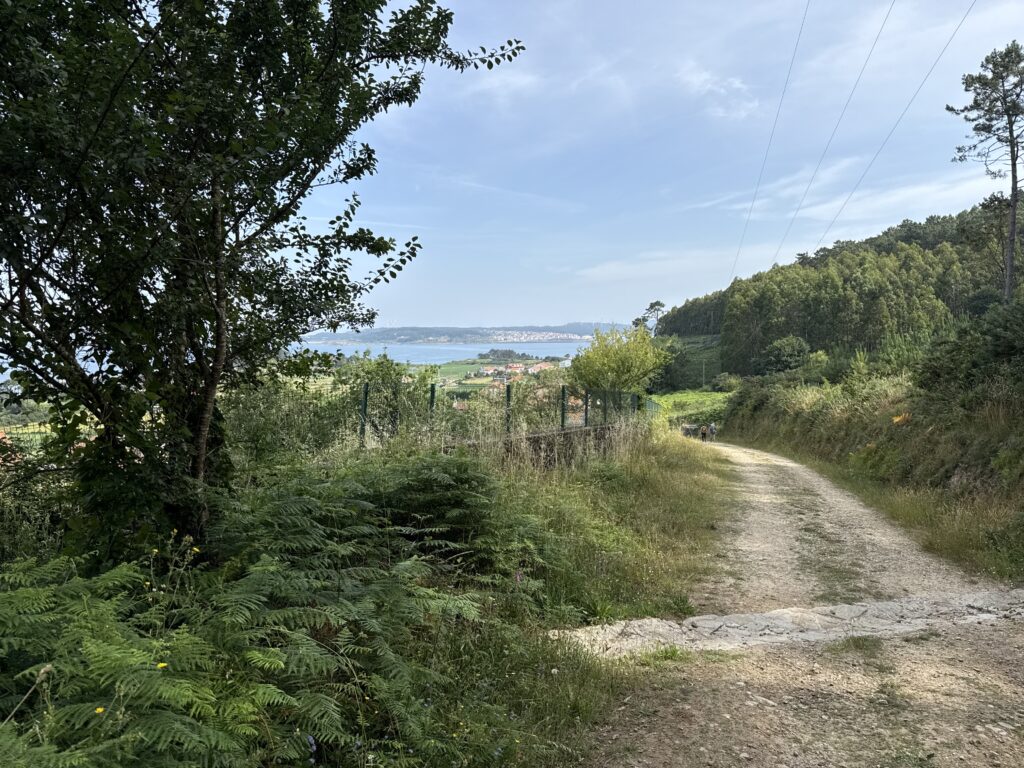
We began our walk at what is for most the finish line – Santiago’s cathedral – setting off on the Finisterre route that runs west to Muxia and Finisterre. Pilgrims completing this route don’t receive the traditional Compostela, but instead the Fisterrana or Muxiana completion certificates. For context, about 4000 were issued in 2024, compared to almost half a million Compostelas. Though we skipped the traditional Camino, others in our group who had walked the route described jammed towns, lines at restaurants, and early-morning dashes to snag a bunk in a hostel. By contrast, our route felt nearly deserted. Most days we would only pass a handful of other pilgrims.
Landscapes, History, and Ancient Roots of the Camino Finsterre
Our itinerary with Spanish Steps stretched about 120 km, weaving from Santiago out to Muxia then down the coast to Finisterre. As walking holidays go, it was fairly mild, with daily mileage of 14 to 20 km (10 to 13 miles). Though the Camino Finisterre is considered an extension of the Camino, the path actually predates Christianity.
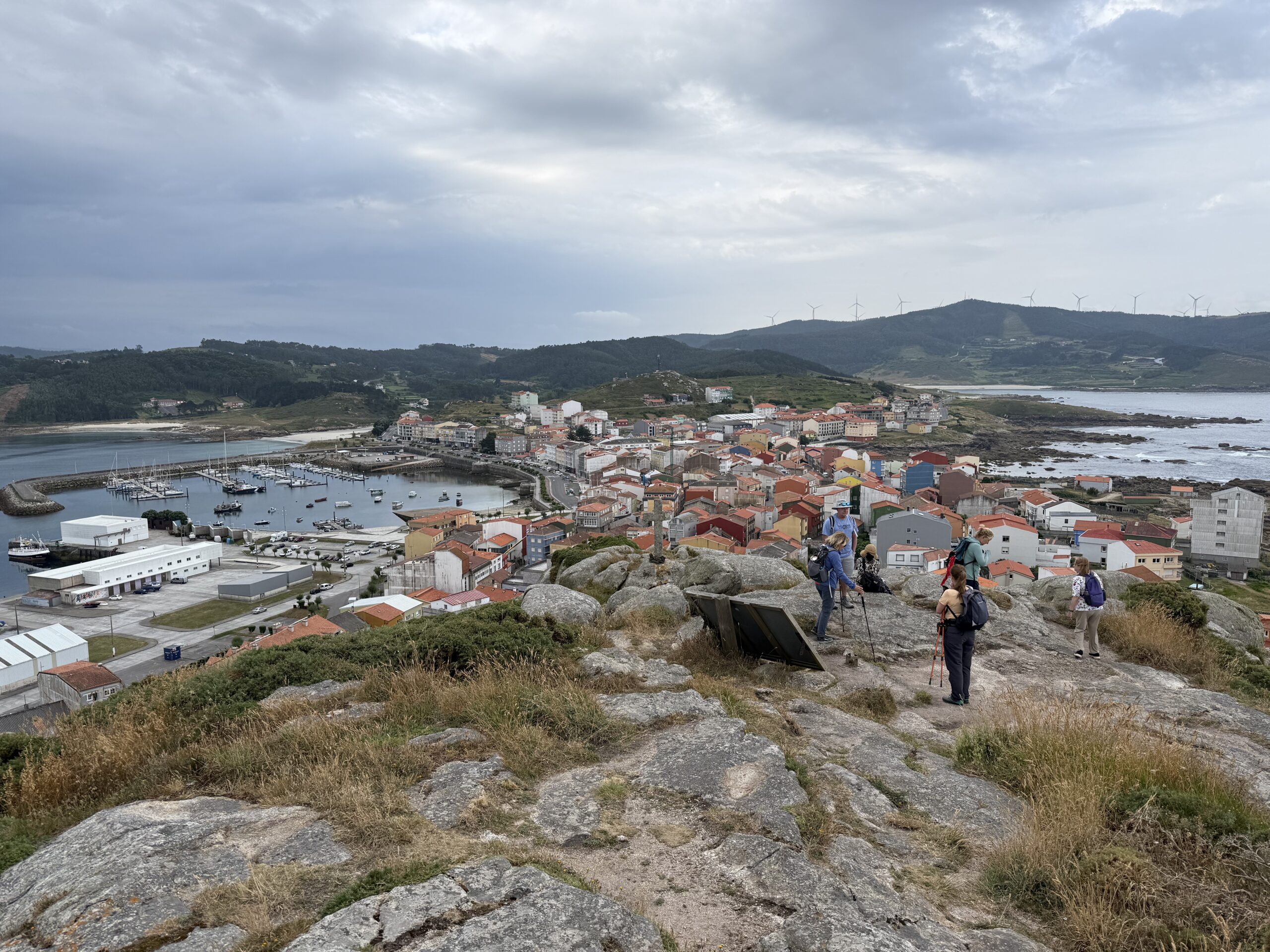
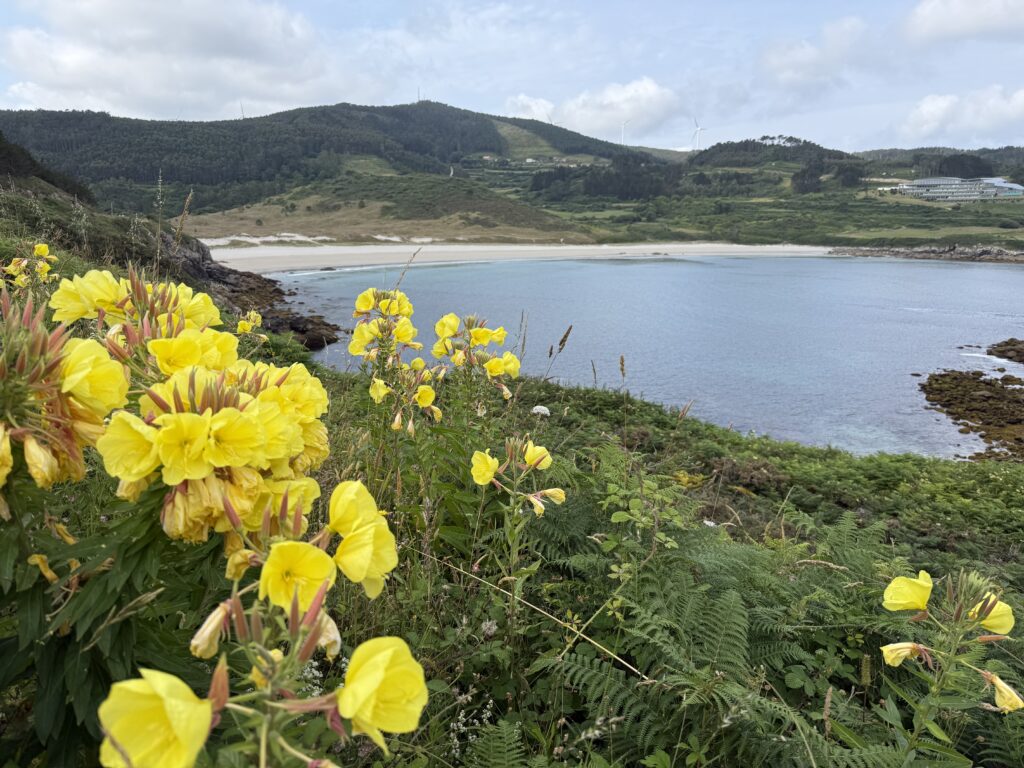
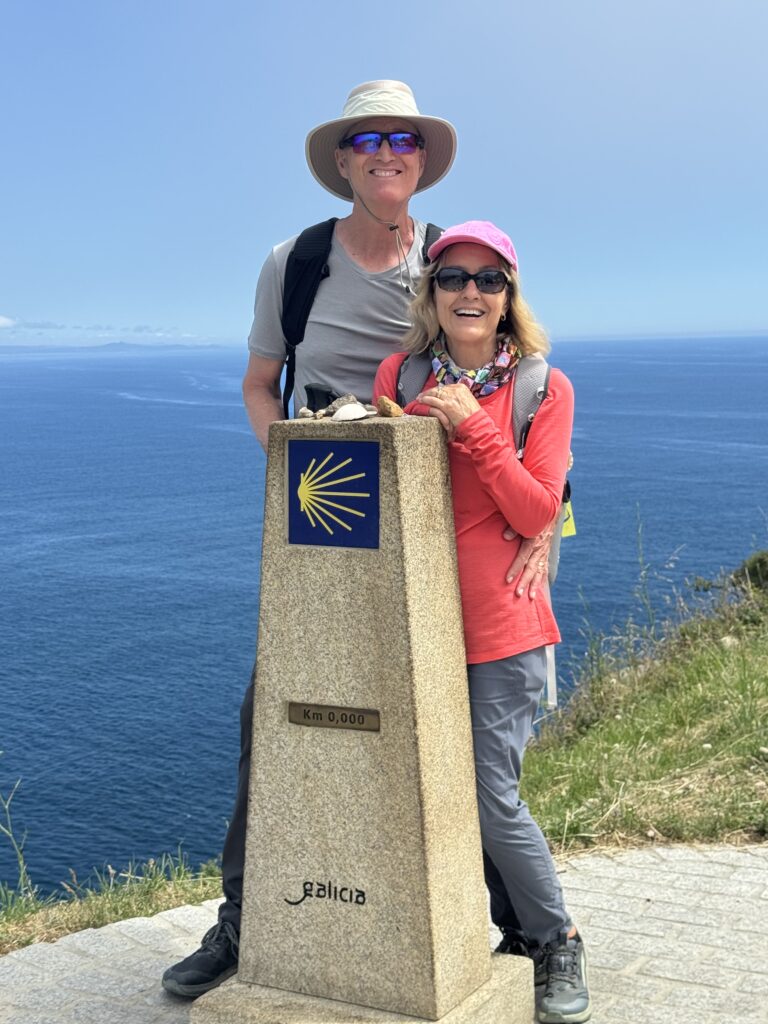
Long before St. James arrived on the Iberian Peninsula, Cape Finisterre represented the very edge of the known world to ancient cultures – a sacred place for sun worship. Walking the route, we traversed rural Galicia, detouring to the fishing village of Muxia, before paralleling the coast south to the dramatic cliffs and lighthouse at Finisterre. We wandered through quiet villages, patchwork fields, rolling hills forested with eucalyptus and pine, and rugged coastal scenery.
We were lucky to have transport for our luggage on those days that we were changing lodging. I enjoy trips more when I’m carrying less, and on this trip I was testing the new Gossamer Gear Aero Jet. I usually travel with even a smaller pack, but the Aero Jet provided great organization, and still fit inside the cabin of even the smaller regional jets. For one day, I experimented by carrying my fully loaded pack, like the pilgrims without van support, and it worked fine. The side pockets were perfect for carrying water and snacks for the day, and I had full access to all my clothes for any changes in weather.
Daily Life Along the Way: Hórreos, Villages, and Rural Galicia
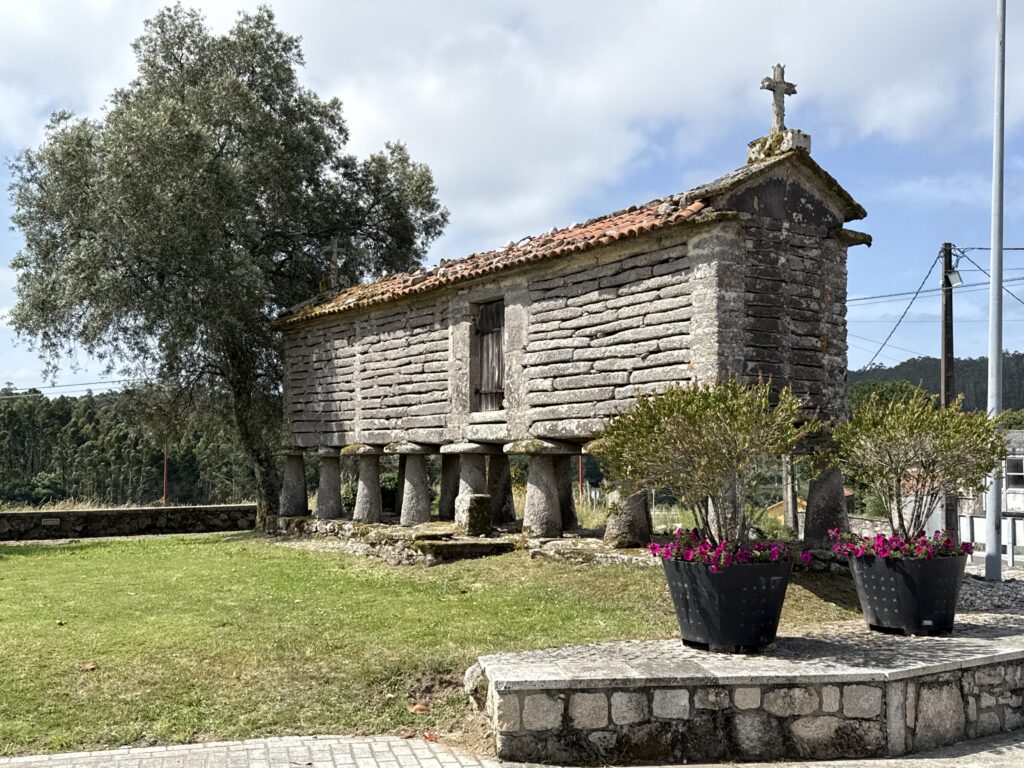
I have a note on my phone titled “Old School” (future book material) where I jot down instances where we still do things the same way as it was done hundreds or even thousands of years ago, because even with the advancements of technology, nobody has found a better way to do it (think pencils, lighthouse lenses, or horseshoes). Galicia’s hórreos fascinated me: elegant, practical storerooms to keep corn dry in a land soaked by up to 2 meters (79 inches) of rain a year.
The granaries are constructed by flat stones stacked with slits between to allow airflow, perched on stone legs with disks to keep the rodents from climbing up them. We saw hórreos that looked like they were hundreds of years old, and we saw ones out of precast concrete that looked like they had just been installed from a Home Depot kit last summer. I figured that the older ones were just left for the tourists, until the day we watched a farmer, halfway through unloading his tractor, filling his weathered hórreo with fresh corn.
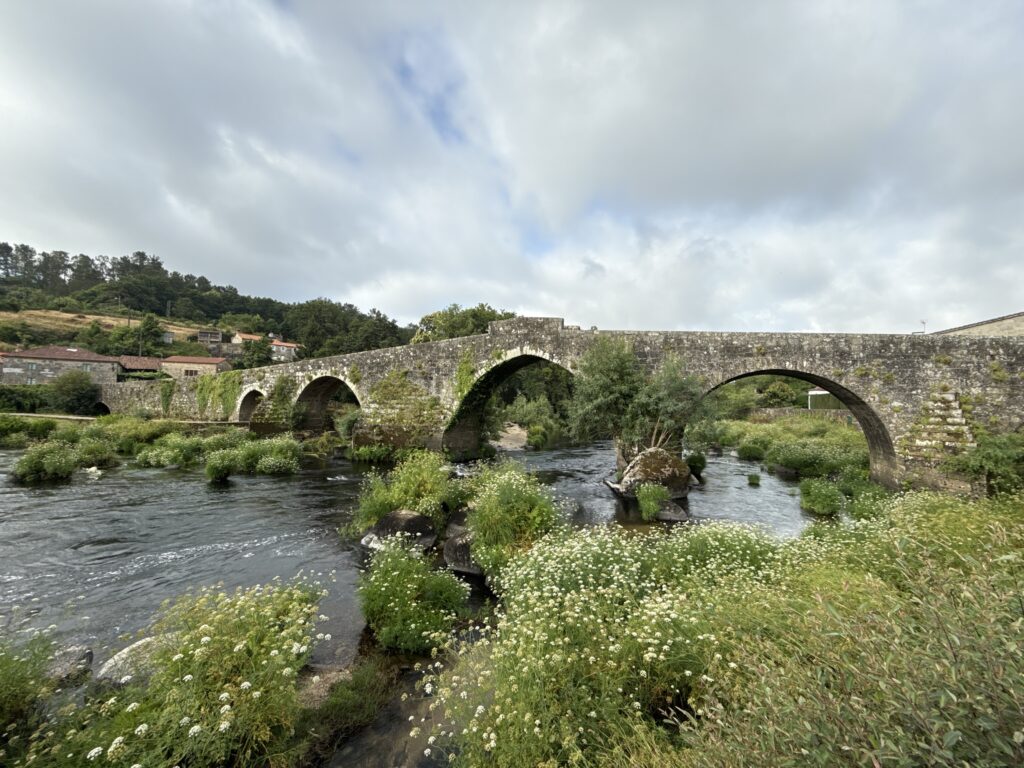
We reveled in the unhurried ambling through the agrarian countryside. I loved the history, like walking over the 14th century bridge at Ponte Maceira. One day a rhythmic click-click-click from under a roadside umbrella revealed a grandma making traditional lace by hand. The ample rainfall of the area resulted in a riot of flowers along our path, including the largest hydrangea bushes I have ever seen. The locals were friendly – in one village we chatted with an elderly man who had worked aboard cargo ships, and had done a stint as a cowboy in Montana before returning to his family home in Galicia.
Shared Tables and Shared Stories on the Camino
The culture experienced by walking through the countryside was great, but the most amazing cultural immersion happened during our stay at Casa Castineira. This rural farmhouse stood out because of the warmth of the family who rebuilt it from two crumbling stone walls. Through our window I watched the dad herding the cows home at dusk, while the mother and grandmother were busy crafting a Galician feast. Kids darted between the kitchen and our long table, delivering plates and occasionally lobbying for their own dinner.
Our visit happened to coincide with St. John’s Eve (also known as Witch’s Night) on the Summer Solstice. We were invited to participate with the family in the reciting of the conxuro da queimada, and drinking the potent flaming punch spiked with a local coffee liquor. Those shared rituals, local flavors, and family stories are the kind of memories you only make by traveling through a land on foot.
One of the underrated gifts of all-day walking for a week is the conversations. Modern life for many of us rarely allows time for more than a quick coffee or perhaps an hour-long lunch before rushing back to our obligations. On the Camino, with miles stretching out before us until dinner, stories unfold naturally. You really get to know the people you’re walking with – their families, their triumphs and tragedies, their joys and despairs.
When you’re walking, the answer “…it’s a long story” is merely an invitation! Time unspools; conversations go deep; we are restored by trading small screens for big questions and shared laughter – or occasionally, a ladder and some hedge clippers.
Glen Van Peski is the founder of Gossamer Gear, and the award-winning author of take less. do more. Surprising Life Lessons in Generosity, Gratitude and Curiosity from an Ultralight Backpacker.
If you enjoyed reading this story, check out some of our other travel guides here!
What is the Camino Finisterre?
The Camino Finisterre is a historic pilgrimage route that begins in Santiago de Compostela and continues west to the Atlantic coast at Finisterre, with an optional branch to Muxía. It is often walked as an extension of the Camino de Santiago.
How long is the Camino Finisterre?
The route from Santiago to Finisterre is about 90 km (56 miles). Including the detour to Muxía brings the total distance to roughly 120 km (75 miles).
How many days does it take to walk the Camino Finisterre?
Most walkers complete the Camino Finisterre in 4 to 6 days, depending on daily mileage and whether they include Muxía.
Is the Camino Finisterre crowded?
No. Compared to the main Camino de Santiago routes, the Camino Finisterre is much quieter. Many days you may only encounter a handful of other pilgrims.
Do you receive a certificate for completing the Camino Finisterre?
Yes. Pilgrims can receive the Fisterrana certificate in Finisterre or the Muxiana in Muxía, though these are different from the traditional Compostela.
Is the Camino Finisterre historically significant?
Yes. The route predates Christianity and leads to Cape Finisterre, once believed to be the edge of the known world. It was an important site for ancient sun-worship and ritual long before medieval pilgrimage.
How difficult is the Camino Finisterre?
The Camino Finisterre is considered moderate. Daily distances are manageable, and the terrain includes rolling hills, rural paths, and some coastal sections rather than steep mountain climbs.

 Kayla Cosmos
 Trevor Carlson
 Cait Charles
 Prapti Shahkumar